History Karate
Karate history can be traced back some 1400 years, to Daruma, founder of Zen Buddhism in Western India. Daruma is said to have introduced Buddhism into China, incorporating spiritual and physical teaching methods that were so demanding that many of his disciples would drop in exhaustion. In order to give them greater strength and endurance, he developed a more progressive training system, which he recorded in a book, Ekkin-Kyo, which can be considered the first book on Karate of all time.
The physical training, heavily imbued with Daruma's philosophical principles, was taught in the Shaolin Temple in the year 500 A.D. Shaolin (Shorin) kung-fu, from northern China, was characterized by very colorful, rapid, and dynamic movements; the Shokei school of southern China was known for more powerful and sober techniques. These two kinds of styles found their way to Okinawa, and had their influence on Okinawa's own original fighting method, called Okinawa-te (Okinawan hand) or simply te. A ban on weapons in Okinawa for two long periods in its history is also partly responsible for the high degree of development of unarmed fighting techniques on the island.
In summary, Karate in Okinawa developed from the synthesis of two fighting techniques. The first one, used by the inhabitants of Okinawa, was very simple but terribly effective and, above all, very close to reality since it was used throughout many centuries in real combat. The second one, much more elaborate and impregnated with philosophical teachings, was a product of the ancient culture of China. These two origins explain the double character of Karate--extremely violent and efficient but at the same time a strict and austere discipline and philosophy with a nonviolent emphasis.
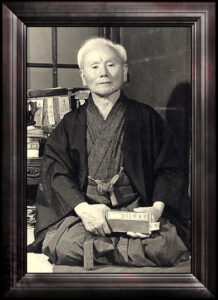
The Influence of Master Funakoshi
Master Gichin Funakoshi was the first expert to introduce Karate-do to mainland Japan, in 1916. One of the few people to have been initiated into all the major Okinawan Karate methods, Master Funakoshi taught a synthesis of the Okinawan styles, as a total discipline. This method became known as Shotokan (literally "house/school (kan) of pine waces (shoto - Funakoshi's pen name)” ). Because of the great popularity of the style in Japan and, later, around the world, Funakoshi is widely considered to be the "father of modern Karate-do."
In May 1949, Nakayama, Isao Obata, and other colleagues helped establish the Japan Karate Association (JKA). Funakoshi was the formal head of the organization, with Nakayama appointed as Chief Instructor as he was the only one without a job and they needed someone to open and close the dojo during the day. By 1951, Nakayama had been promoted to 3rd dan, and he held the rank of 5th dan by 1955. In 1956, working with Teruyuki Okazaki, he restructured the Shotokan karate training program to follow both traditional karate and methods developed in modern sports sciences. In 1961, Nakayama was promoted to 8th dan—a remarkable progression, in part made possible by the consensus-based system of higher dan promotion in Japan at the time, according to Pat Zalewski. Nakayama established kata (patterns) and kumite (sparring) as tournament disciplines. Students of the large JKA dojo (training halls) subsequently achieved an unmatched series of tournament successes in the 1950s and 1960s.
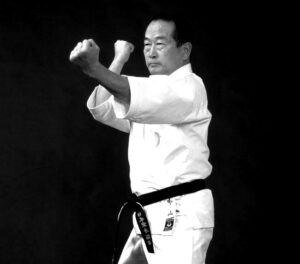
Keigo Abe (阿部 圭吾, Abe Keigo, October 28, 1938 – December 21 2019, Matsuyama, Ehime - Ken, Shikoku, Japan) was a prominent Japanese master of Shotokan karate who founded the Japan Shotokan Karate Association in 1999 and is its Chief Instructor. He holds the rank of 9th dan in karate, is a direct student of Masatoshi Nakayama (1913–1987), and was a senior instructor in the Japan Karate Association.
In 1961, Abe fought a notable tournament match against Keinosuke Enoeda, losing by decision after six extensions. He graduated from the JKA instructors' training program in 1965, and was a long-serving member of the instructing team at JKA's honbu dojo. Like other kenshusei (junior instructors) of the day, Abe would practice his techniques on the streets against local gangsters to improve his fighting skills. Through Nakayama, Abe worked on the James Bond film You Only Live Twice (1967). Nakayama had been invited to appear in the movie, but was unable to do so due to prior commitments, and so recommended Abe instead.
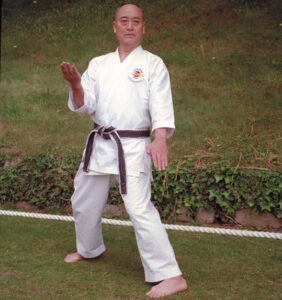
Nakayama wrote that Abe's strengths were his backfist technique and his use of distancing, strengths also noted by others years later. He had an accomplished record as a karate tournament competitor, taking first place in the inaugural JKA National Championship, first place in the team competition at the 1973 JKA International Friendship Tournament, and first place in the second and third Japan Karatedo Federation National Championships (representing Tokyo).
Abe had a close working relationship with Nakayama, benefiting from his technical knowledge and assisting him with teaching. He was one of several instructors who demonstrated techniques in Nakayama's books on karate. In 1985, two years before Nakayama's death, Abe was appointed as Director of Qualifications in the JKA. After the division of the JKA in 1990, he became the Technical Director of the JKA (Matsuno faction). He was responsible for formulating the ippon shobu tournament rules, which are used by most Shotokan karate competitors today.
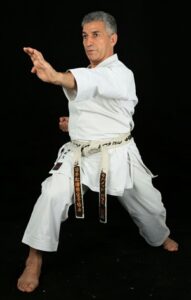
Master Mohammad Bahrami, who is considered one of the first students of Master Mohammad Ali Sharifi, started karate with him in 1974. His training took a more serious form in 1976 under the supervision of his instructor as well as Sensei Kigo Abe. He returned to Iran in early 2007 after about 40 years of activity in this field and winning various national and national titles with 16 years of coaching experience for the national teams of Kuwait and the United Arab Emirates. After returning, he was appointed as the head of the coaching committee of the Karate Federation of the Islamic Republic of Iran. In order to expand his knowledge and also to transfer the experiences he had gained during this period, he established the Shotokan Karate Association of Iran.
Professor Bahrami has accompanied the Japanese Shotokan Karate Association (JSKA) since its establishment in 1999 by Professor Abe and now represents the association in Iran, Kuwait and Afghanistan. Asian karate development were appointed. It is worth mentioning that Professor Mohammad Bahrami was honored with a degree of eight in 2013.